
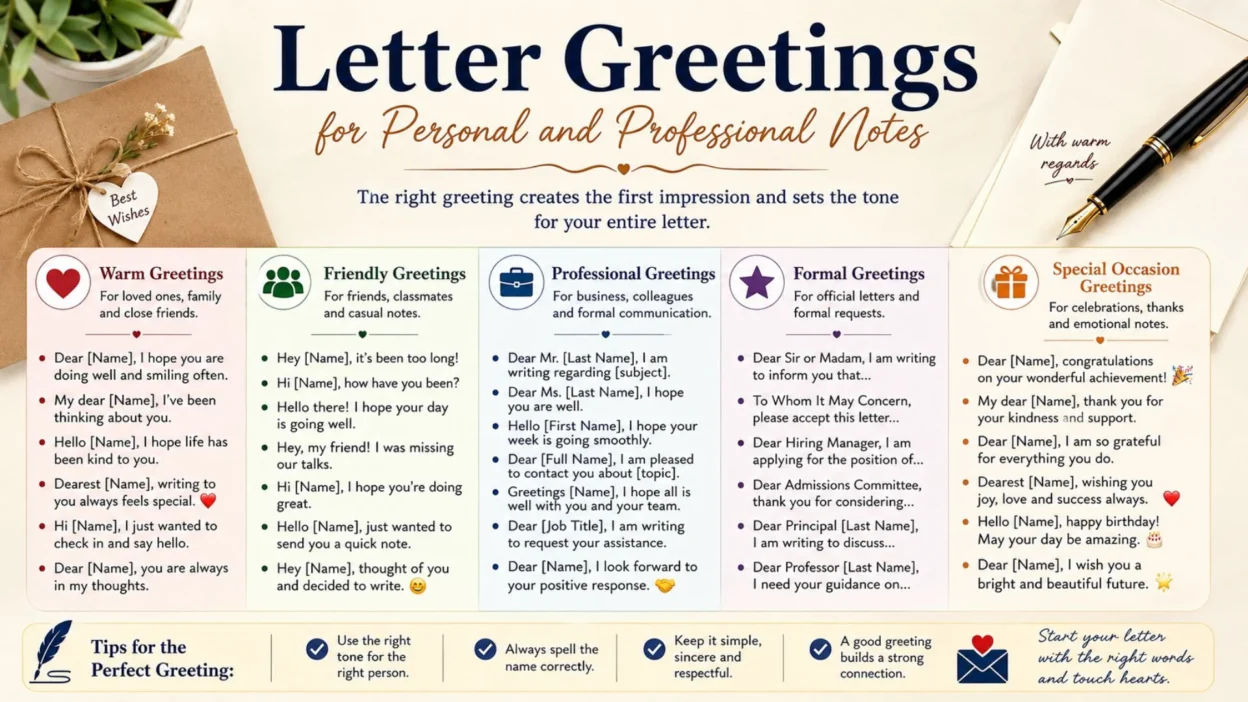
Starting a letter can feel surprisingly difficult, even when you already know what you want to say.
The first few words set the tone, so the wrong greeting may sound too formal, overly casual, or emotionally distant.
The best letter greetings help you connect with the reader while matching your relationship and reason for writing.
Whether you are contacting a friend, relative, colleague, customer, teacher, or someone you have never met, a thoughtful opening makes your message feel complete.
This collection gives you practical greetings that you can copy, personalize, and use without spending time searching for the right words.
Choose the option that fits your situation, then continue naturally with the main purpose of your letter.
Warm Letter Greetings for Someone You Know Well
Personal letters should begin with warmth and familiarity. These greetings work well for close friends, relatives, partners, and other people who are already part of your life.
- Dear [Name], I hope you are doing well and finding plenty of reasons to smile these days.
- My dear [Name], I have been thinking about you and wanted to put a few heartfelt thoughts into writing.
- Hello [Name], I hope life has been treating you kindly since we last spoke.
- Dearest [Name], it always brings me happiness to write to you and feel connected, even from a distance. ❤️
- Hi [Name], I wanted to take a quiet moment to reach out and let you know that you have been on my mind.
- Dear [Name], I hope this letter finds you peaceful, healthy, and surrounded by people who care about you.
- My wonderful [Name], there are some things that feel more meaningful when they are written from the heart.
- Hello, my friend. I hope your days have been going well and that something beautiful has made you smile recently. 😊
- Dear [Name], although life can become busy, I never want too much time to pass without checking in with you.
Professional Openings That Sound Polished, Not Cold
A professional greeting should show respect without making the letter feel robotic. Use these openings for colleagues, clients, managers, business partners, service providers, and workplace contacts.
- Dear Mr. [Last Name], I am writing regarding [subject] and appreciate your time and attention.
- Dear Ms. [Last Name], I hope you are well. I would like to discuss an important matter concerning [topic].
- Dear Dr. [Last Name], thank you for taking the time to review my letter and consider my request.
- Hello [First Name], I hope your week is going smoothly. I am reaching out to follow up on our recent conversation.
- Dear [Full Name], I am pleased to contact you regarding an opportunity that may be valuable to both of us.
- Greetings [Name], I hope all is well with you and your team. I am writing to share a brief update about [project].
- Dear [Job Title or Department], I am contacting you to request assistance with [specific issue or question].
- Hello [Name], thank you for your continued support. I wanted to provide you with the latest information about [subject].
- Dear [Name], I hope you are having a productive day. I would appreciate your guidance regarding [matter].
- Good morning [Name], I am writing to confirm the details of our upcoming meeting and ensure everything is properly arranged.
- Dear [Name], it was a pleasure speaking with you recently, and I look forward to continuing our conversation. 🤝
Friendly Greetings for Casual Letters and Notes
Casual letter greetings work best when you want to sound relaxed, approachable, and genuine. They are useful for old friends, classmates, neighbors, cousins, and people you know in an informal setting.
- Hey [Name], it has been far too long, and I thought it was finally time to sit down and write to you.
- Hi [Name], I hope everything is going well and that life has brought you some exciting moments lately.
- Hello there! I wanted to send you a little note and brighten your day with a friendly message. 🌟
- Hey, my friend. I was remembering some of our good times and suddenly felt like writing to you.
- Hi [Name], how have you been? I would love to hear what has been happening in your life recently.
- Hello [Name], I hope your day is going well. I have some news to share that I think you will enjoy.
- Hey [Name], I know we usually send quick messages, but this time I wanted to write something a little more meaningful.
- Hi there, I hope you are staying happy, healthy, and busy with things that bring you joy.
- Hello, lovely person! This note comes with warm thoughts and a reminder that you are truly appreciated. 💛
- Hey [Name], I came across something that reminded me of you, and I could not resist reaching out.
- Hi [Name], I hope this letter brings a smile to your face and adds a little happiness to your day. 😊
- Hello, old friend. No matter how much time passes, I still value the memories and connection we share.
Here is the next section with practical greetings for formal, emotional, and special situations.
Respectful Greetings for Formal Letters
Formal letters often require a careful and respectful opening. These letter greetings are suitable for government offices, institutions, senior professionals, school administrators, legal contacts, and other official recipients.
- Dear Sir or Madam, I am writing to request information regarding [subject] and would appreciate your assistance.
- To Whom It May Concern, please accept this letter as a formal statement concerning [matter].
- Dear Hiring Manager, I am pleased to submit my application for the position of [job title].
- Dear Admissions Committee, thank you for considering my application and reviewing the information provided.
- Dear Principal [Last Name], I am writing to discuss an important matter related to [student, class, or school issue].
- Dear Professor [Last Name], I hope you are well. I am contacting you to request your advice regarding [academic topic].
- Dear Customer Service Team, I am writing to seek a fair and timely resolution to an issue involving [product or service].
- Dear Members of the Committee, thank you for allowing me the opportunity to present my request for consideration.
- Dear Office Manager, I would appreciate your assistance in clarifying the requirements for [document, appointment, or process].
- Dear [Official Title and Last Name], I respectfully submit this letter for your review and appropriate action.
Heartfelt Openings for Emotional Letters
When a letter carries deep feelings, the greeting should create a gentle and sincere beginning. These lines can help you express love, gratitude, concern, regret, or emotional support.
- My dear [Name], I have carried these thoughts in my heart for some time, and today I finally found the courage to write them down.
- Dearest [Name], some feelings are difficult to explain in conversation, so I hope this letter speaks honestly for my heart.
- Dear [Name], before I say anything else, I want you to know how deeply grateful I am to have you in my life.
- My beloved [Name], distance may separate us physically, but you remain close to me in every thought and memory. ❤️
- Dear [Name], I know you are facing a difficult season, and I wanted to remind you that you do not have to face it alone.
- My precious friend, this letter comes with love, understanding, and the hope that brighter days will soon find you.
- Dear [Name], I am writing with a sincere heart because our relationship means too much to leave important feelings unspoken.
- My dear [Name], I hope these words bring you some comfort and remind you how much you are loved and valued. 🌷
Thoughtful Greetings for Thank-You Letters
A thank-you letter feels more meaningful when it begins with genuine appreciation. Use these openings to thank someone for a gift, favor, opportunity, support, hospitality, or act of kindness.
- Dear [Name], I want to begin by expressing my sincere gratitude for everything you did for me.
- Hello [Name], your kindness meant more than I can fully explain, and I did not want to let it pass without thanking you.
- Dear [Name], thank you for being so generous with your time, support, and thoughtful guidance.
- My dear [Name], I am still touched by your kindness and wanted to tell you how much your gesture meant to me.
- Dear [Name], your support arrived exactly when I needed it most, and I will always be grateful for your care.
- Hello [Name], please accept my heartfelt thanks for making [occasion or experience] so memorable and special.
- Dear [Name], I truly appreciate the confidence you placed in me by offering this valuable opportunity.
- My wonderful friend, your thoughtful gift brought me so much happiness and reminded me how fortunate I am to know you. 🎁
- Dear [Name], thank you for welcoming me so warmly and making me feel comfortable throughout my visit.
- Hello [Name], your encouraging words gave me strength during a challenging time, and I will not forget your support.
- Dear [Name], I am deeply grateful for the patience and understanding you showed when I needed them most.
- My dear [Name], sometimes a simple thank-you does not feel like enough, but please know that your kindness truly touched my heart.
Gentle Beginnings for Apology Letters
An apology letter should begin honestly without making excuses. These greetings help you acknowledge the situation, accept responsibility, and prepare the reader for a sincere message.
- Dear [Name], I am writing because I owe you an honest and heartfelt apology.
- My dear [Name], I have thought carefully about what happened, and I deeply regret the hurt my actions caused.
- Dear [Name], I know my words affected you, and I am truly sorry for not showing the care and respect you deserved.
- Hello [Name], I do not want pride or discomfort to stop me from admitting that I was wrong.
- Dear [Name], please allow me to apologize sincerely for the misunderstanding and frustration I caused.
- My dear friend, our relationship matters greatly to me, which is why I want to take responsibility for my mistake.
- Dear [Name], I understand that an apology cannot immediately undo the damage, but I hope it can begin the process of healing.
- Hello [Name], I am sorry for disappointing you and for failing to handle the situation with greater thoughtfulness.
- Dear [Name], I should have listened more carefully and responded with patience instead of reacting too quickly.
- My dear [Name], I am writing with genuine regret and the hope that, in time, I can rebuild your trust. 🙏
- Dear [Name], you deserved honesty and consideration from me, and I am sorry that I did not provide either in that moment.
Encouraging Letter Greetings for Difficult Times
The right opening can bring comfort to someone facing illness, grief, stress, disappointment, or uncertainty. These greetings offer support without sounding forced or dismissive.
- Dear [Name], I have been thinking about you often and wanted to send a few words of comfort and encouragement.
- My dear friend, I know this is not an easy time, but I hope you remember how many people care about you.
- Dear [Name], you may not feel strong every day, and that is completely understandable. Please be gentle with yourself.
- Hello [Name], I wanted to remind you that one difficult chapter does not define your entire story.
- Dear [Name], although I cannot remove your pain, I am here to listen, support you, and walk beside you.
- My dear [Name], please take each day slowly and allow yourself the time and space you need to heal. 🌿
- Dear [Name], I believe in your ability to move through this challenge, even if progress feels slow right now.
- Hello [Name], you do not need to have every answer today. Taking one small step at a time is enough.
- Dear [Name], I hope this letter gives you a quiet reminder that you are valued, remembered, and never alone.
Here is the final part with additional greetings, practical FAQs, a conclusion, and the meta description.
Letter Greetings When You Do Not Know the Recipient
Sometimes you need to write before learning the recipient’s name. These greetings help you remain respectful and professional without making your opening feel outdated or impersonal.
- Dear Customer Support Team, I am writing to request assistance with an issue related to [product, order, or service].
- Dear Recruitment Team, I would like to express my interest in the available [job title] position.
- Dear Admissions Office, I am contacting you to learn more about the application process for [course or program].
- Dear Event Coordinator, I am writing to request additional information about the upcoming [event name].
- Dear Accounts Department, I would appreciate your help in reviewing a payment matter concerning [invoice or account].
- Greetings, I hope this letter reaches the appropriate person who can assist me with [specific request].
Whenever possible, search for the recipient’s name or job title before using a general greeting. A personalized opening usually creates a stronger and more respectful first impression.
Cheerful Openings for Celebration Letters
Celebration letters should feel joyful from the beginning. These openings are ideal for birthdays, weddings, graduations, anniversaries, promotions, new homes, and other happy milestones.
- Dear [Name], congratulations on this wonderful achievement and the exciting new chapter ahead of you!
- My dear [Name], today is a beautiful opportunity to celebrate the happiness, growth, and success you deserve. 🎉
- Dear [Name], I am delighted to share in your joy and send my warmest wishes on this special occasion.
- Hello [Name], your wonderful news brought a huge smile to my face, and I could not be happier for you.
- Dearest [Name], may this meaningful milestone become the beginning of many more joyful memories.
- Dear [Name], congratulations on reaching a goal that reflects your patience, courage, and hard work.
- My wonderful friend, this celebration feels even more special because I know how much effort brought you here. 🌟
- Dear [Name], I hope this happy moment fills your heart with pride and gives you many reasons to look forward to the future.
Welcoming Greetings for New Connections
Writing to someone for the first time can feel uncertain. A friendly but respectful greeting helps introduce you naturally while making the reader feel comfortable.
- Dear [Name], I hope you are well. My name is [your name], and I am reaching out regarding [reason].
- Hello [Name], it is a pleasure to connect with you, and I appreciate the opportunity to introduce myself.
- Dear [Name], [mutual contact’s name] suggested that I contact you because of your experience with [subject].
- Hello [Name], I recently learned about your work in [field] and wanted to reach out with a brief question.
- Dear [Name], although we have not met yet, I hope this letter can begin a positive and valuable connection.
- Greetings [Name], I am pleased to contact you and look forward to learning more about [topic or opportunity].
- Dear [Name], thank you for taking a moment to read my letter. I hope we can discuss [specific matter] soon.
How to Choose the Right Letter Greeting
The best greeting depends on your relationship with the recipient, the purpose of your letter, and the tone you want to create.
Use “Dear [Name]” when you want a safe and flexible option. It works in personal, formal, and professional letters.
Choose “Hello [Name]” when you want to sound friendly and modern without becoming too casual.
Use titles such as Mr., Ms., Dr., Professor, or Principal when respect and professional formality are important.
For close relationships, greetings such as “My dear [Name]” or “Dearest [Name]” can create a warmer emotional tone.
Avoid overly casual openings such as “Hey” in complaints, applications, official requests, or first-time professional communication.
Always check the spelling of the recipient’s name. A thoughtful letter can lose its positive effect when the name or title is written incorrectly.
Common Letter Greeting Mistakes to Avoid
Even a strong message can begin poorly when the greeting does not match the situation. Review these common mistakes before sending your letter.
- Do not use a nickname unless you know the recipient is comfortable with it.
- Avoid guessing someone’s gender, title, marital status, or preferred form of address.
- Do not use romantic or deeply emotional greetings in professional communication.
- Avoid using “To Whom It May Concern” when a department name or job title is available.
- Do not add several greetings together, such as “Dear Hello Mr. Smith.”
- Avoid excessive punctuation, capital letters, or multiple emojis in formal letters.
- Do not forget the comma after a casual greeting or the colon commonly used after a highly formal greeting.
- Avoid copying a greeting without changing placeholders such as [Name], [Company], or [Subject].
Frequently Asked Questions About Letter Greetings
What is the best general greeting for a letter?
“Dear [Name]” is the safest general option. It works for personal letters, business communication, applications, thank-you notes, and formal requests. You can adjust the level of formality by using a first name, full name, title, or surname.
Can I start a professional letter with “Hello”?
Yes, “Hello [Name]” is acceptable in many modern workplaces. It sounds friendly and professional, especially when you already know the person. However, “Dear [Title and Last Name]” may be more suitable for legal, academic, government, or highly formal communication.
What should I write when I do not know the person’s name?
Use a specific role or department whenever possible, such as “Dear Hiring Manager,” “Dear Admissions Team,” or “Dear Customer Service Department.” These options usually sound more thoughtful than “To Whom It May Concern.”
Should I use a comma or a colon after a letter greeting?
A comma is common in personal and everyday professional letters, such as “Dear Sarah,” or “Hello James,”. A colon can be used in very formal business correspondence, such as “Dear Hiring Manager:”. Choose one style and use it consistently.
How can I make a letter greeting feel more personal?
Use the recipient’s correct name and mention a sincere thought immediately after the greeting. For example, you might refer to a recent conversation, shared memory, important achievement, or reason for writing. Keep it natural and avoid exaggerated praise.
Conclusion
The right letter greetings make it easier to begin your message with confidence, warmth, and respect.
A professional opening can create trust, while a heartfelt greeting can help someone feel valued, remembered, and supported.
Before choosing your words, consider who will read the letter and how you want that person to feel.
You can copy these greetings directly or personalize them with names, situations, memories, and specific details.
Whether your letter shares gratitude, encouragement, celebration, concern, or an important request, a thoughtful beginning gives every word that follows greater meaning.