
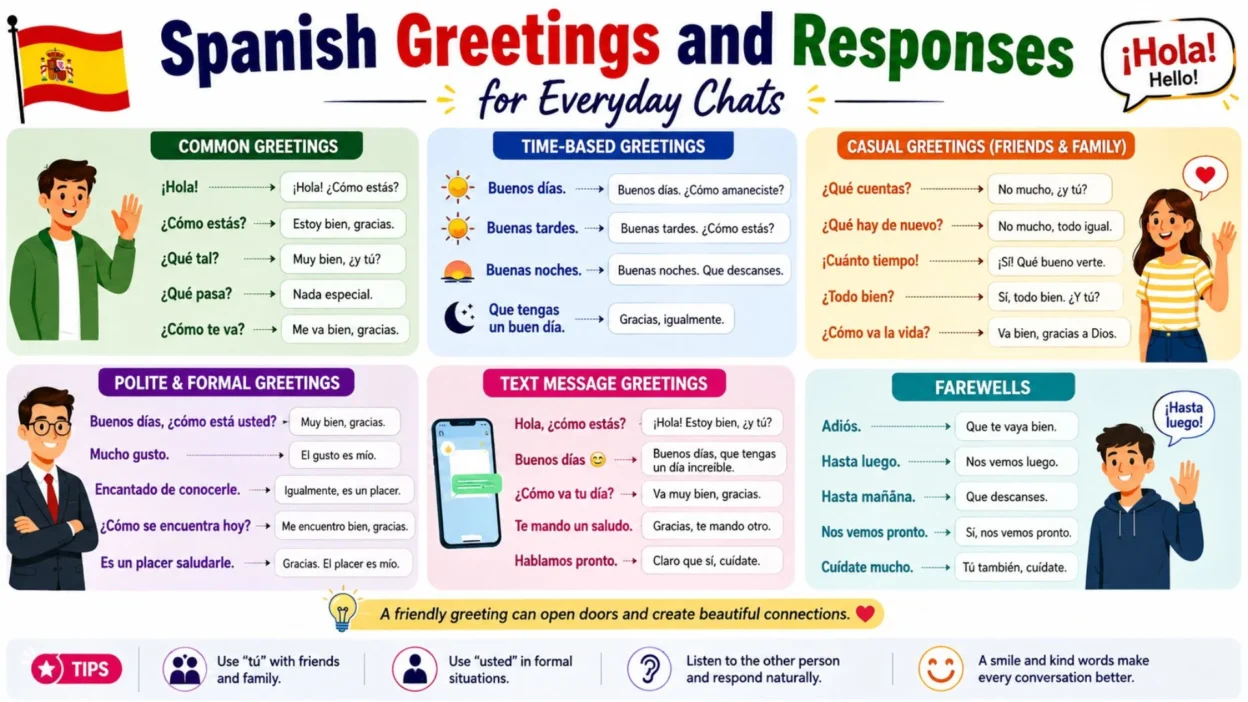
Starting a conversation in Spanish can feel exciting, but choosing the right words is not always easy. You may know how to say “hello,” yet still wonder what to say when someone replies.
These Spanish greetings and responses will help you communicate naturally in real-life situations. Each example includes a suitable reply and a simple English meaning.
Whether you are speaking with a friend, coworker, neighbor, or Spanish-speaking customer, you can quickly find a phrase that fits. You will also learn when to use formal, casual, and time-based greetings.
Common Spanish Greetings and Responses
These everyday expressions work well in relaxed conversations. Use them when meeting friends, classmates, relatives, neighbors, or people you already know.
- Greeting: ¡Hola! Response: ¡Hola! ¿Cómo estás? Meaning: Hello! — Hello! How are you?
- Greeting: Hola, ¿qué tal? Response: Muy bien, gracias. ¿Y tú? Meaning: Hi, how are things? — Very good, thank you. And you?
- Greeting: ¿Cómo estás? Response: Estoy bien, gracias. Meaning: How are you? — I am fine, thank you.
- Greeting: ¿Cómo te va? Response: Me va bastante bien. Meaning: How is it going? — It is going quite well.
- Greeting: ¿Qué pasa? Response: Nada especial. ¿Y contigo? Meaning: What is happening? — Nothing special. What about you?
- Greeting: ¿Qué hay de nuevo? Response: No mucho. Todo sigue igual. Meaning: What is new? — Not much. Everything is still the same.
- Greeting: ¡Cuánto tiempo! Response: ¡Sí! Me alegra mucho verte. 😊 Meaning: Long time no see! — Yes! I am very happy to see you.
- Greeting: ¿Cómo has estado? Response: He estado bien. Gracias por preguntar. Meaning: How have you been? — I have been well. Thanks for asking.
- Greeting: ¿Todo bien? Response: Sí, todo bien. ¿Y tú? Meaning: Is everything okay? — Yes, everything is fine. And you?
- Greeting: ¡Qué alegría verte! Response: ¡Igualmente! Me alegra encontrarte. Meaning: It is wonderful to see you! — Likewise! I am happy to see you.
- Greeting: Hola, amigo. ¿Cómo va todo? Response: Todo va bien, amigo. Meaning: Hello, my friend. How is everything going? — Everything is going well.
Polite Spanish Greetings for Formal Situations
A respectful greeting creates a positive first impression. These phrases are useful when speaking with older adults, teachers, managers, customers, officials, or people you have just met.
- Greeting: Buenos días, ¿cómo está usted? Response: Muy bien, gracias. ¿Y usted? Meaning: Good morning, how are you? — Very well, thank you. And you?
- Greeting: Mucho gusto. Response: El gusto es mío. Meaning: Nice to meet you. — The pleasure is mine.
- Greeting: Encantado de conocerle. Response: Igualmente, es un placer. Meaning: Pleased to meet you. — Likewise, it is a pleasure.
- Greeting: ¿Cómo se encuentra hoy? Response: Me encuentro muy bien, gracias. Meaning: How are you feeling today? — I am feeling very well, thank you.
- Greeting: Es un placer saludarle. Response: Muchas gracias. El placer es mío. Meaning: It is a pleasure to greet you. — Thank you very much. The pleasure is mine.
- Greeting: Bienvenido. Nos alegra recibirle. Response: Muchas gracias por la bienvenida. Meaning: Welcome. We are happy to have you. — Thank you very much for the welcome.
- Greeting: Espero que se encuentre bien. Response: Gracias. Espero que usted también. Meaning: I hope you are well. — Thank you. I hope you are too.
- Greeting: ¿Cómo ha estado, señor García? Response: Muy bien, gracias por preguntar. Meaning: How have you been, Mr. García? — Very well, thank you for asking.
- Greeting: Qué gusto volver a verle. Response: Igualmente. Ha pasado mucho tiempo. Meaning: It is nice to see you again. — Likewise. It has been a long time.
In Spanish, tú is normally used in casual conversations. However, usted shows greater respect and formality. When you are unsure, starting with “usted” is usually the safer choice.
Time-Based Spanish Greetings and Natural Replies
Spanish speakers often choose greetings according to the time of day. The exact timing can vary by country, but these expressions are widely understood.
- Greeting: Buenos días. Response: Buenos días. ¿Cómo amaneció? ☀️ Meaning: Good morning. — Good morning. How are you this morning?
- Greeting: Buenos días, ¿dormiste bien? Response: Sí, dormí muy bien. Gracias. Meaning: Good morning, did you sleep well? — Yes, I slept very well. Thank you.
- Greeting: Buenas tardes. Response: Buenas tardes. ¿Cómo está? Meaning: Good afternoon. — Good afternoon. How are you?
- Greeting: Feliz tarde. Response: Gracias. Que tengas una tarde agradable. Meaning: Have a happy afternoon. — Thank you. Have a pleasant afternoon.
- Greeting: Buenas noches. Response: Buenas noches. Espero que haya tenido un buen día. Meaning: Good evening. — Good evening. I hope you had a good day.
- Greeting: Que tengas una linda noche. Response: Gracias. Tú también. 🌙 Meaning: Have a lovely evening. — Thank you. You too.
- Greeting: ¿Cómo estuvo tu día? Response: Estuvo muy bien, aunque un poco ocupado. Meaning: How was your day? — It was very good, although a little busy.
- Greeting: Espero que hayas tenido un buen día. Response: Gracias. Fue un día bastante agradable. Meaning: I hope you had a good day. — Thank you. It was a pleasant day.
Simple Tips for Using Spanish Greetings Naturally
A greeting sounds more natural when it matches the situation. For example, “¿Qué pasa?” works well between friends, but it may sound too casual during a business meeting.
Also, remember that responses do not need to be long. A short answer such as “Muy bien, gracias” is polite and suitable for many situations.
When someone asks “¿Y tú?”, they are returning the question to you. In a formal conversation, they may say “¿Y usted?” instead.
Finally, pay attention to the other person’s tone. A warm smile, relaxed voice, and friendly greeting can make even a simple “Hola” feel more personal. 👋
Casual Spanish Greetings and Responses for Friends
Relaxed greetings help conversations feel warm and natural. These phrases are ideal for friends, cousins, classmates, and people you speak with regularly.
- Greeting: ¡Hola! ¿Cómo andas? Response: Muy bien. ¿Y tú, cómo andas? Meaning: Hi! How are you doing? — Very well. And how are you doing?
- Greeting: ¿Qué tal todo? Response: Todo tranquilo, por suerte. Meaning: How is everything? — Everything is calm, thankfully.
- Greeting: ¿Qué cuentas? Response: No mucho. He estado bastante ocupado. Meaning: What have you been up to? — Not much. I have been quite busy.
- Greeting: ¡Ey! ¿Cómo te va? Response: Me va genial. ¿Qué tal tú? Meaning: Hey! How is it going? — It is going great. How about you?
- Greeting: ¿Cómo va la vida? Response: Va bien, con algunos días mejores que otros. Meaning: How is life going? — It is going well, with some days better than others.
- Greeting: ¿Todo tranquilo? Response: Sí, todo tranquilo por aquí. Meaning: Is everything calm? — Yes, everything is calm here.
- Greeting: ¡Mira quién está aquí! Response: ¡Por fin nos encontramos! Meaning: Look who is here! — We finally meet!
- Greeting: ¡Qué sorpresa verte! Response: También me sorprendió encontrarte aquí. Meaning: What a surprise to see you! — I was also surprised to find you here.
- Greeting: ¿Cómo está la familia? Response: Todos están bien. Gracias por preguntar. ❤️ Meaning: How is the family? — Everyone is well. Thank you for asking.
- Greeting: Me alegra saber de ti. Response: A mí también. Tenemos mucho de qué hablar. Meaning: I am glad to hear from you. — Me too. We have a lot to talk about.
Friendly Responses When You Are Not Feeling Great
You do not always need to say that everything is perfect. Spanish speakers often use honest but polite responses when they are tired, worried, or having a difficult day.
- Question: ¿Cómo estás? Response: Estoy un poco cansado, pero bien. Meaning: How are you? — I am a little tired, but fine.
- Question: ¿Todo bien? Response: Más o menos, pero espero sentirme mejor pronto. Meaning: Is everything okay? — More or less, but I hope to feel better soon.
- Question: ¿Cómo te sientes? Response: No me siento muy bien hoy. Meaning: How do you feel? — I do not feel very well today.
- Question: ¿Qué tal tu día? Response: Ha sido difícil, pero mañana será otro día. Meaning: How has your day been? — It has been difficult, but tomorrow is another day.
- Question: ¿Cómo va todo? Response: He tenido días mejores, sinceramente. Meaning: How is everything going? — I have had better days, honestly.
These replies sound sincere without revealing more than you wish to share. You can then add “Gracias por preguntar” to show appreciation.
When texting someone for the first time, begin with “Hola” and introduce yourself. This avoids confusion and makes your message feel more respectful.
Professional Spanish Greetings for Work and Business
Workplace greetings should sound polite without feeling cold. Use these examples in offices, meetings, customer conversations, interviews, and professional messages.
- Greeting: Buenos días, ¿cómo está? Response: Muy bien, gracias. ¿Cómo está usted? Meaning: Good morning, how are you? — Very well, thank you. How are you?
- Greeting: Es un gusto conocerle. Response: Igualmente. Gracias por su tiempo. Meaning: It is a pleasure to meet you. — Likewise. Thank you for your time.
- Greeting: Bienvenido a nuestro equipo. Response: Muchas gracias. Me alegra estar aquí. Meaning: Welcome to our team. — Thank you very much. I am happy to be here.
- Greeting: Gracias por reunirse conmigo. Response: Con mucho gusto. Gracias por la invitación. Meaning: Thank you for meeting with me. — My pleasure. Thank you for the invitation.
- Greeting: Espero que esté teniendo un buen día. Response: Muchas gracias. Espero que usted también. Meaning: I hope you are having a good day. — Thank you very much. I hope you are too.
- Greeting: ¿Cómo va el trabajo? Response: Va bien. Estamos avanzando según lo previsto. Meaning: How is the work going? — It is going well. We are progressing as planned.
- Greeting: Me alegra volver a verle. Response: Igualmente. Es bueno trabajar juntos de nuevo. Meaning: I am pleased to see you again. — Likewise. It is good to work together again.
- Greeting: ¿En qué puedo ayudarle? Response: Necesito información sobre este servicio. Meaning: How can I help you? — I need information about this service.
- Greeting: Gracias por ponerse en contacto con nosotros. Response: Gracias por responder tan rápido. Meaning: Thank you for contacting us. — Thank you for responding so quickly.
Starting a Professional Email in Spanish
For a formal email, you can begin with “Estimado señor”, “Estimada señora”, or the person’s name. In a more general message, “Buenos días” or “Buenas tardes” is also suitable.
Avoid using very casual expressions such as “¿Qué pasa?” in professional communication. Instead, choose respectful phrases that match your relationship with the reader.
Spanish Greetings for Travel and Meeting New People
These expressions can help you at hotels, restaurants, airports, tours, shops, and social events. They are polite, simple, and easy for beginners to remember.
- Greeting: Hola, soy Daniel. Mucho gusto. Response: Mucho gusto, Daniel. Me llamo Elena. Meaning: Hello, I am Daniel. Nice to meet you. — Nice to meet you, Daniel. My name is Elena.
- Greeting: Disculpe, ¿habla inglés? Response: Sí, hablo un poco de inglés. Meaning: Excuse me, do you speak English? — Yes, I speak a little English.
- Greeting: Buenos días. ¿Puede ayudarme? Response: Claro. ¿Qué necesita? Meaning: Good morning. Can you help me? — Of course. What do you need?
- Greeting: Hola, es mi primera vez aquí. Response: ¡Bienvenido! Espero que disfrute su visita. Meaning: Hello, it is my first time here. — Welcome! I hope you enjoy your visit.
- Greeting: ¿De dónde eres? Response: Soy de Pakistán. ¿Y tú? Meaning: Where are you from? — I am from Pakistan. And you?
- Greeting: ¿Estás disfrutando del viaje? Response: Sí, lo estoy pasando muy bien. ✈️ Meaning: Are you enjoying the trip? — Yes, I am having a wonderful time.
- Greeting: Encantado de conocerte. Response: Igualmente. Espero que volvamos a vernos. Meaning: Pleased to meet you. — Likewise. I hope we meet again.
- Greeting: Que disfrutes tu estancia. Response: Muchas gracias. Todos han sido muy amables. Meaning: Enjoy your stay. — Thank you very much. Everyone has been very kind.
- Greeting: Bienvenido a nuestra ciudad. Response: Gracias. Estoy encantado de estar aquí. Meaning: Welcome to our city. — Thank you. I am delighted to be here.
Choose affectionate words carefully. Expressions such as “mi amor” and “cariño” may sound romantic, although family members also use them in some Spanish-speaking cultures.
Spanish Greetings for Birthdays and Celebrations
Special occasions deserve more than an ordinary hello. These greetings are suitable for birthdays, holidays, achievements, weddings, and other joyful moments.
- Greeting: ¡Feliz cumpleaños! Espero que tengas un día inolvidable. Response: Muchas gracias por tus buenos deseos. Meaning: Happy birthday! I hope you have an unforgettable day. — Thank you very much for your good wishes.
- Greeting: ¡Felicidades por tu logro! Response: Gracias. Trabajé mucho para conseguirlo. Meaning: Congratulations on your achievement! — Thank you. I worked hard to achieve it.
- Greeting: ¡Felices fiestas para ti y tu familia! Response: Muchas gracias. Felices fiestas para ustedes también. 🎉 Meaning: Happy holidays to you and your family! — Thank you. Happy holidays to you too.
- Greeting: Te deseo un feliz año nuevo. Response: Igualmente. Que el nuevo año te traiga mucha alegría. Meaning: I wish you a happy New Year. — Likewise. May the new year bring you great happiness.
- Greeting: ¡Felicidades por su boda! Response: Muchas gracias por acompañarnos en este día. Meaning: Congratulations on your wedding! — Thank you for joining us on this day.
- Greeting: Que disfrutes mucho esta celebración. Response: Gracias. Me alegra poder compartirla contigo. Meaning: I hope you enjoy this celebration. — Thank you. I am happy to share it with you.
- Greeting: ¡Qué alegría celebrar contigo! Response: Tu presencia hace este momento más especial. Meaning: What a joy to celebrate with you! — Your presence makes this moment more special.
- Greeting: Mis mejores deseos en este día tan importante. Response: Gracias por tus palabras tan amables. Meaning: My best wishes on this important day. — Thank you for your kind words.
When you know the person well, add a personal detail to your greeting. For example, you can mention their achievement, kindness, or the happiness they bring to others.
Spanish Farewells and Suitable Responses
Ending a conversation politely is just as important as beginning one. These farewells help you leave naturally while showing respect, warmth, or interest in speaking again.
- Farewell: Adiós. Response: Adiós. Que te vaya bien. Meaning: Goodbye. — Goodbye. I hope things go well for you.
- Farewell: Hasta luego. Response: Nos vemos más tarde. Meaning: See you later. — We will see each other later.
- Farewell: Hasta mañana. Response: Hasta mañana. Que descanses. Meaning: See you tomorrow. — See you tomorrow. Rest well.
- Farewell: Nos vemos pronto. Response: Claro. Espero verte pronto. Meaning: See you soon. — Of course. I hope to see you soon.
- Farewell: Que tengas un buen día. Response: Gracias. Igualmente. Meaning: Have a good day. — Thank you. You too.
- Farewell: Cuídate mucho. Response: Tú también. Gracias por todo. Meaning: Take good care of yourself. — You too. Thank you for everything.
- Farewell: Fue un placer conocerte. Response: El placer fue mío. Meaning: It was a pleasure meeting you. — The pleasure was mine.
- Farewell: Gracias por la conversación. Response: Gracias a ti. Me gustó mucho hablar contigo. Meaning: Thank you for the conversation. — Thank you. I really enjoyed talking with you.
- Farewell: Buenas noches. Que duermas bien. Response: Gracias. Que tengas dulces sueños. 🌙 Meaning: Good night. Sleep well. — Thank you. Sweet dreams.
In casual conversations, “Nos vemos” is one of the easiest ways to say goodbye. Meanwhile, “Fue un placer hablar con usted” is more suitable for formal situations.
Frequently Asked Questions About Spanish Greetings and Responses
What is the most common greeting in Spanish?
“Hola” is the most common and flexible Spanish greeting. It means “hello” or “hi” and can be used at almost any time of day. You can follow it with “¿Cómo estás?” in casual situations or “¿Cómo está usted?” in formal conversations.
How should I respond when someone says “¿Cómo estás?”
A simple response is “Estoy bien, gracias. ¿Y tú?”, which means “I am fine, thank you. And you?” You can also say “Muy bien”, “Todo bien”, or “Más o menos”, depending on how you feel.
What is the difference between “tú” and “usted”?
“Tú” is informal and is commonly used with friends, relatives, children, and people of a similar age. “Usted” is formal and shows respect. It is often used with older adults, customers, officials, and people you do not know well.
Can “buenas” be used as a Spanish greeting?
Yes. In many Spanish-speaking regions, people use “Buenas” as a relaxed form of “good morning,” “good afternoon,” or “good evening.” It is friendly and common, although “Buenos días” or “Buenas tardes” may be better in formal settings.
Do all Spanish-speaking countries use the same greetings?
Most basic greetings are understood everywhere. However, casual expressions and levels of formality can vary between Spain, Mexico, Argentina, Colombia, and other Spanish-speaking countries. Therefore, begin with widely understood phrases until you become familiar with local language habits.
Conclusion
Learning Spanish greetings and responses makes everyday conversations easier, warmer, and more natural. You do not need to memorize every phrase at once. Instead, begin with “Hola,” “¿Cómo estás?” and a few simple replies.
Then, choose formal or casual language based on the person and situation. You can also use affectionate phrases with loved ones and polite expressions in professional settings.
These ready-to-use examples can help you communicate while traveling, texting, working, or meeting someone new. Save your favorite phrases and practice them during real conversations. Even a simple greeting can create a meaningful connection when it is shared with kindness.