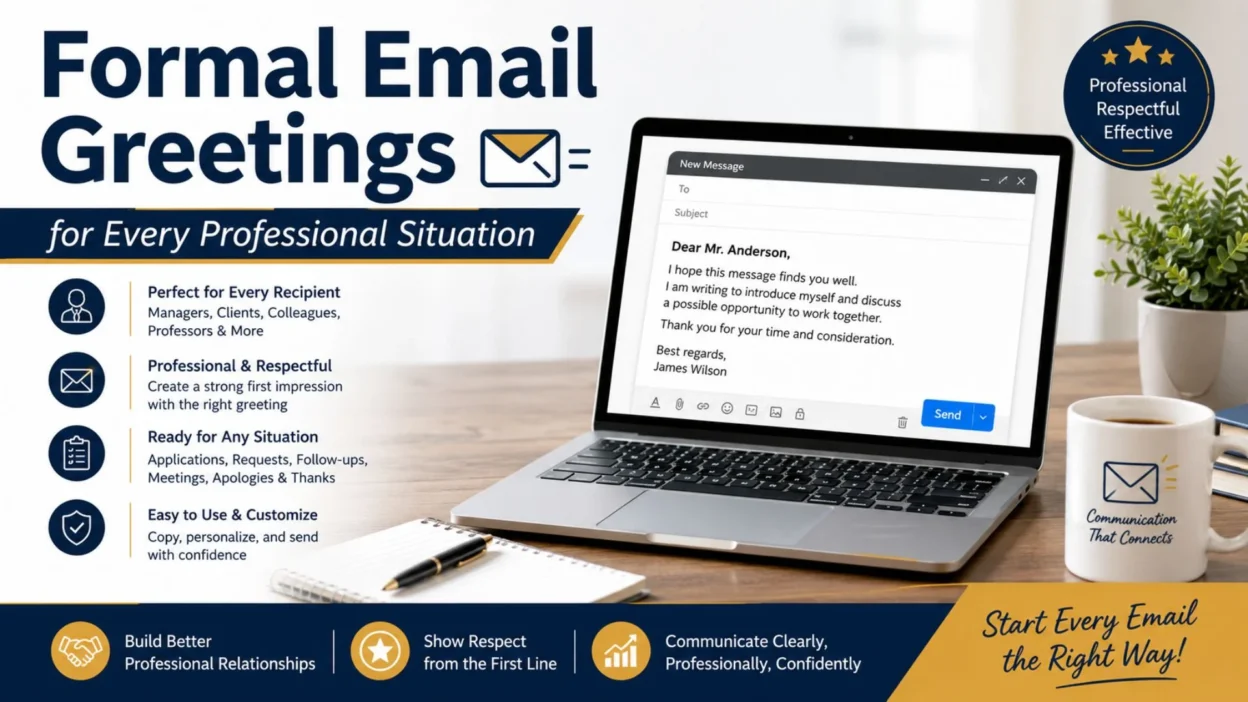
Writing the first line of a professional email can feel surprisingly difficult. You may know exactly what you want to say but still hesitate over whether to write “Hello,” “Dear,” or something more formal. The wrong greeting can sound cold, overly casual, or unsuitable for the person receiving your message. These formal email greetings will help you begin workplace and business emails with confidence. Each example is written for a realistic situation, so you can quickly choose, copy, and personalize the right one. Whether you are contacting someone for the first time or writing to a senior professional, you will find a suitable opening below.
Choosing Formal Email Greetings Without Sounding Stiff
A formal greeting should show respect while still sounding natural. The best choice depends on your relationship with the recipient, their position, and the purpose of your email.
Use “Dear” when writing to senior professionals, recruiters, government departments, academic staff, or someone you have never contacted before. It is traditional, respectful, and suitable for most formal situations.
Use “Hello” when you want to sound professional but slightly more approachable. It works well for colleagues, clients, service providers, and people with whom you already have some contact.
Whenever possible, include the recipient’s name. A greeting such as “Dear Ms. Taylor” feels more thoughtful and professional than a broad phrase such as “Dear Sir or Madam.”
You should also check the spelling of the recipient’s name and use the correct title. A small mistake in the greeting may create a careless first impression, especially in a job application or important business request.
Formal Email Greetings for a First Introduction
When contacting someone for the first time, your greeting should immediately communicate respect. These options work well for introductions, business inquiries, networking, and professional requests.
- Dear Mr. Anderson, I hope you are doing well. My name is Daniel Harris, and I am contacting you regarding a potential business opportunity.
- Dear Ms. Williams, I hope this message finds you well. I am writing to introduce myself and discuss the possibility of working together.
- Dear Dr. Roberts, I hope you are having a pleasant week. I recently came across your work and wanted to contact you directly.
- Hello Mr. Thompson, I hope all is well. I am reaching out to introduce myself and ask for your guidance regarding an upcoming project.
- Dear Professor Martin, I hope you are well. My name is Sarah, and I am interested in learning more about your research program.
- Good morning, Ms. Brown, I hope your day is going well. I am contacting you on behalf of our organization to discuss a possible collaboration.
- Dear Alex, It is a pleasure to connect with you. I was referred to you by Michael Reed, who suggested that I contact you about our proposal.
- Hello Jennifer, I hope you are having a productive day. I wanted to introduce myself before sharing some information about our services. 🙂
- Dear Mr. Wilson, Please allow me to introduce myself. I am the new account coordinator responsible for supporting your organization.
Polished Openers for Managers, Clients, and Senior Leaders
Emails sent to people in senior positions should be respectful without becoming unnecessarily complicated. The following greetings create a professional tone while allowing the rest of your message to remain clear and conversational.
- Dear Ms. Parker, I hope you are doing well. I am writing to provide an update on the project we discussed during Monday’s meeting.
- Good morning, Mr. Lewis, I wanted to share the latest progress report and request your feedback on the proposed timeline.
- Dear Director Evans, I hope this message finds you well. I am contacting you regarding the policy changes announced earlier this month.
- Hello Ms. Adams, I hope your week is going smoothly. I would appreciate the opportunity to discuss the next steps for our campaign.
- Dear Managing Director, I am writing to request your approval for the revised budget and implementation schedule.
- Good afternoon, Mr. Carter, Thank you for your continued support. I have attached the completed documents for your review.
- Dear Mrs. Turner, I hope you are keeping well. I wanted to follow up on our previous conversation about the contract renewal.
- Hello David, I trust you are well. Please find below a brief summary of the results achieved during the last quarter.
- Dear Ms. Foster, I hope your day is going well. I am pleased to share that our team has completed the first stage of the assignment. ✅
- Good morning, Dr. Walker, I am writing to confirm the arrangements for next week’s presentation and to clarify two points regarding the agenda.
- Dear Mr. Collins, Thank you for taking the time to review my request. I greatly appreciate your consideration and professional guidance.
Respectful Greetings When You Do Not Know the Recipient
Sometimes an email address does not reveal the name of the person who will read your message. In these situations, use a role, department, or team name instead of making assumptions about the recipient’s identity.
- Dear Hiring Manager, I am writing to apply for the marketing coordinator position advertised on your company website.
- Dear Recruitment Team, Please accept my application for the available administrative role within your organization.
- Dear Customer Support Team, I am contacting you to request assistance with an issue affecting my account.
- Dear Admissions Officer, I would be grateful for information regarding the application requirements for international students.
- Dear Finance Department, I am writing to request clarification regarding the invoice issued on 15 July.
- Dear Sir or Madam, I am contacting you to inquire about the professional services offered by your organization.
- To Whom It May Concern, I am writing to confirm that Mr. James Cooper was employed by our company from January 2022 to June 2026.
- Greetings, I hope you are well. Could you please direct this message to the person responsible for partnership inquiries?
Formal Email Greetings for Job Applications
A job application email is often your first direct interaction with an employer. Your greeting should be respectful, accurate, and confident, while the opening sentence should clearly explain the position you are applying for.
- Dear Hiring Manager, I am writing to submit my application for the position of Sales Executive recently advertised on your careers page.
- Dear Ms. Richardson, Please accept my application for the role of Human Resources Assistant at Greenfield Solutions.
- Dear Recruitment Officer, I hope you are doing well. I am pleased to submit my résumé and supporting documents for your consideration.
- Good morning, Mr. Bennett, I am contacting you regarding the Business Development Manager vacancy advertised on LinkedIn.
- Dear Talent Acquisition Team, I would like to express my interest in the Graduate Training Program beginning this September.
- Hello Ms. Cooper, I hope your week is going well. I am writing to apply for the Customer Service Representative position.
- Dear Recruitment Manager, Having reviewed the role carefully, I believe my experience and skills closely match the requirements listed in the advertisement.
- Dear Mr. Mitchell, Thank you for considering my application for the Senior Accountant position. I have attached the requested documents for your review.
- Good afternoon, Ms. Hall, I am excited to apply for the available Graphic Designer role and share examples of my recent work. ✨
- Dear Selection Committee, I am writing to formally apply for the scholarship opportunity offered by your institution for the coming academic year.
When sending a job application, avoid casual greetings such as “Hey,” “Hi there,” or “Dear friend.” You should also avoid addressing the recipient by their first name unless they have already communicated with you that way.
Professional Greetings for Follow-Up Emails
A follow-up email should feel polite rather than demanding. Begin with a courteous greeting, briefly mention the earlier conversation or request, and make it easy for the recipient to understand why you are contacting them again.
- Dear Mr. Phillips, I hope you are well. I wanted to follow up regarding the proposal I shared with you last Thursday.
- Hello Maria, I hope you had a pleasant weekend. I am checking in to see whether you have had an opportunity to review the attached report.
- Dear Ms. Howard, I am writing to follow up on my previous email concerning the contract amendments.
- Good morning, Dr. Campbell, I wanted to kindly check whether any further information is required from me before the application can be processed.
- Dear Customer Relations Team, I am following up on the complaint submitted earlier this month and would appreciate an update on its current status.
- Hello James, I hope everything is going well. I wanted to revisit our conversation about arranging a meeting with your project team.
- Dear Ms. Hughes, Thank you again for speaking with me last week. I am following up to confirm the next stage of the interview process.
- Good afternoon, Mr. Morgan, I am writing to check whether a decision has been made regarding the quotation provided on 10 July.
- Dear Admissions Team, I hope you are doing well. Could you please confirm whether my supporting documents have been received successfully?
- Hello Rebecca, I wanted to send a gentle reminder regarding the approval required before we can proceed with the launch. 🔔
- Dear Professor Clark, I am following up on my earlier request for a letter of recommendation and understand that you may have a busy schedule.
- Good morning, Ms. Stewart, I hope your day is going smoothly. I would be grateful for any update you can provide regarding my request. 🙂
Give the recipient a reasonable amount of time before following up. For routine workplace emails, waiting two to three business days is often appropriate. Applications, official requests, and customer service cases may require a longer response period.
Courteous Openings for Requests and Enquiries
When asking someone for information, approval, assistance, or a favor, your email should not begin with a command. A respectful greeting followed by a clear and considerate request makes the recipient more willing to help.
- Dear Mr. Scott, I hope this message finds you well. I am writing to request your approval for the revised project schedule.
- Good morning, Ms. Green, Could you please provide further information about the registration process and required documents?
- Dear Support Team, I would appreciate your assistance in resolving a payment issue connected to my account.
- Hello Daniel, I hope you are well. Would it be possible to arrange a short meeting to discuss the concerns raised by the client?
- Dear Office Administrator, I am writing to request a copy of my employment verification letter for official use.
- Good afternoon, Dr. Young, I would be grateful if you could clarify the assessment criteria for the final assignment.
- Dear Ms. Baker, I hope your week is progressing well. May I request an extension until Friday to complete the revised presentation?
- Hello Mr. King, Could you please review the attached document and share your comments when convenient?
- Dear Visa Information Team, I am contacting you to request confirmation of the entry requirements applicable to my circumstances. 🌍
Formal Greetings for Apologies and Sensitive Situations
Sensitive emails require extra care because the recipient may already feel disappointed, inconvenienced, or concerned. Begin respectfully, acknowledge the issue honestly, and avoid greetings that sound cheerful or overly casual.
- Dear Ms. Nelson, I am writing to sincerely apologize for the delay in responding to your message.
- Dear Mr. Hill, Please accept my apologies for the misunderstanding caused by the information shared in my previous email.
- Good morning, Mrs. Roberts, I regret to inform you that we will be unable to complete the delivery by the originally agreed date.
- Dear Client Services Team, I am contacting you regarding an error in the documents submitted yesterday and would like to provide the corrected versions.
- Hello Andrew, I apologize for missing our scheduled meeting and understand the inconvenience this may have caused.
- Dear Professor Adams, I am sorry that I was unable to submit the assignment before the deadline due to unexpected circumstances.
- Dear Ms. Morris, Thank you for bringing this matter to my attention. I sincerely regret the frustration you experienced.
- Good afternoon, Mr. Ward, I am writing to acknowledge the mistake in our invoice and confirm that a corrected copy has now been issued.
- Dear Team, I understand that the recent change created additional work, and I appreciate your patience while we resolve the matter. 🙏
Warm but Formal Greetings for Colleagues and Teams
Not every professional email needs to sound highly official. When writing to colleagues or familiar team members, you can use a warmer greeting while maintaining workplace respect.
- Good morning, everyone, I hope you are all doing well. I am sharing the agenda for tomorrow’s planning meeting.
- Hello Team, Thank you for your hard work this week. Please find the latest project updates below.
- Dear Colleagues, I hope you are having a productive week. I would like to provide a brief update regarding our upcoming training session.
- Good afternoon, everyone, I am writing to confirm the responsibilities assigned during our previous meeting.
- Hello Marketing Team, I hope your day is going smoothly. Please review the attached campaign draft and share your feedback by Thursday.
- Dear Project Team, Thank you for your continued cooperation. We have now reached an important stage of the project.
- Good morning, Sarah, I hope you are well. Could we arrange a convenient time to review the client’s latest comments?
- Hello Michael, Thank you for sending the revised figures. I have reviewed them and included a few questions below.
- Dear Team Members, I appreciate everyone’s flexibility and support during this particularly busy period. 🌟
- Good afternoon, colleagues, Please accept my thanks for your valuable contributions during yesterday’s discussion.
- Hello Everyone, I am pleased to share that we have successfully completed the first phase of the assignment.
In internal workplace emails, “Hello Team” and “Good morning, everyone” usually sound more natural than highly traditional greetings. However, you should still consider your company culture and the seniority of the people included in the message.
Formal Email Greetings for Meetings and Appointments
Meeting emails should quickly establish the purpose of the message. Whether you are requesting, confirming, rescheduling, or cancelling an appointment, begin politely and provide the essential details clearly.
- Dear Ms. Edwards, I hope you are well. I am writing to request a meeting to discuss the proposed partnership.
- Good morning, Mr. Harris, I would like to confirm our meeting scheduled for Wednesday at 10:00 a.m.
- Hello Rachel, Thank you for arranging the appointment. I look forward to speaking with you tomorrow.
- Dear Dr. Allen, I am contacting you to ask whether our consultation could be moved to a later time on Friday.
- Good afternoon, Mr. Wright, Please accept my apologies, but I need to reschedule our meeting due to an unexpected commitment.
- Dear Committee Members, I hope you are doing well. Please find attached the agenda and supporting documents for our next meeting.
- Hello Patrick, I am writing to confirm that the conference room has been reserved for our presentation.
- Dear Ms. Cook, Thank you for accepting my meeting request. I have included the discussion points below for your convenience.
- Good morning, everyone, This is a friendly reminder that our monthly review meeting will begin at 9:30 a.m. tomorrow. ⏰
- Dear Mr. Bailey, I appreciate your time and look forward to discussing the matter with you in greater detail.
Thank-You Greetings for Professional Emails
A thoughtful thank-you email can strengthen professional relationships and show that you value someone’s time, assistance, or support. Mention what you are grateful for instead of sending a vague expression of thanks.
- Dear Ms. Murphy, Thank you for taking the time to review my application and provide such helpful feedback.
- Good morning, Mr. Rivera, I sincerely appreciate your assistance in resolving the issue so quickly.
- Hello Laura, Thank you for your support during yesterday’s presentation. Your guidance made a meaningful difference.
- Dear Professor White, I am grateful for the recommendation letter you prepared on my behalf.
- Good afternoon, Ms. Brooks, Thank you for meeting with me to discuss the position and answer my questions about the role.
- Dear Customer Support Team, I appreciate your prompt response and the professional way in which you handled my request.
- Hello Robert, Thank you for sharing your experience and offering practical advice regarding the project.
- Dear Mr. Gray, I am writing to express my sincere appreciation for the confidence you have placed in our team.
- Good morning, Team, Thank you for your dedication, patience, and excellent work throughout this demanding week. 👏
These messages are most effective when sent promptly. Adding one specific detail about the person’s help makes your appreciation feel genuine rather than routine.
Common Formal Email Greeting Mistakes to Avoid
Even a well-written email can create the wrong impression if its opening feels careless. Before sending your message, check the greeting for these common problems:
- Avoid greetings such as “Hey,” “Yo,” or “Hi buddy” in formal communication.
- Do not misspell the recipient’s name, especially when it appears correctly in their email address or signature.
- Avoid assuming someone’s gender or preferred title. When uncertain, use their full name or professional role.
- Do not write “Dear Sir” when the recipient may be a woman or when several people may receive the email.
- Avoid excessive punctuation, such as “Hello!!!” because it can appear unprofessional.
- Do not use “To Whom It May Concern” when you can easily identify the recipient’s name or department.
- Avoid beginning with “I need” or “Send me” before offering a greeting or courteous introduction.
- Do not use overly personal questions about health, family, or private matters unless you know the recipient well.
A simple greeting that is accurate and respectful is usually better than an elaborate one that sounds unnatural.
Frequently Asked Questions
What is the safest formal email greeting?
“Dear [Name]” is one of the safest options for formal emails. It works well for applications, official requests, senior professionals, academic communication, and first-time contact.
Is “Hello” professional enough for a formal email?
Yes. “Hello [Name]” is professional and slightly warmer than “Dear [Name].” It is suitable for clients, colleagues, recruiters, and business contacts, particularly when the relationship is already established.
What should I write when I do not know the recipient’s name?
Use the person’s role or department, such as “Dear Hiring Manager,” “Dear Admissions Team,” or “Dear Customer Support Team.” These greetings are more specific and natural than “To Whom It May Concern.”
Should I write “Hi” or “Dear” in a job application?
“Dear” is generally the stronger choice for a job application, especially when contacting an employer for the first time. “Hello” can also work, but “Hi” may feel too casual in traditional industries.
Is “Good morning” suitable for formal emails?
Yes, especially when you know the recipient will receive the message that morning. However, emails are not always opened immediately, so “Dear [Name]” or “Hello [Name]” may be more practical for messages sent across different time zones.
Conclusion
The right greeting sets the tone before the recipient reaches the main purpose of your email. These formal email greetings can help you write confidently to employers, clients, managers, colleagues, and unfamiliar recipients. Choose an opening that reflects your relationship with the reader and the seriousness of the situation. Then personalize it with the correct name, role, or reason for contacting them. A respectful beginning does not need to sound cold or complicated—it only needs to feel thoughtful, clear, and sincere.