
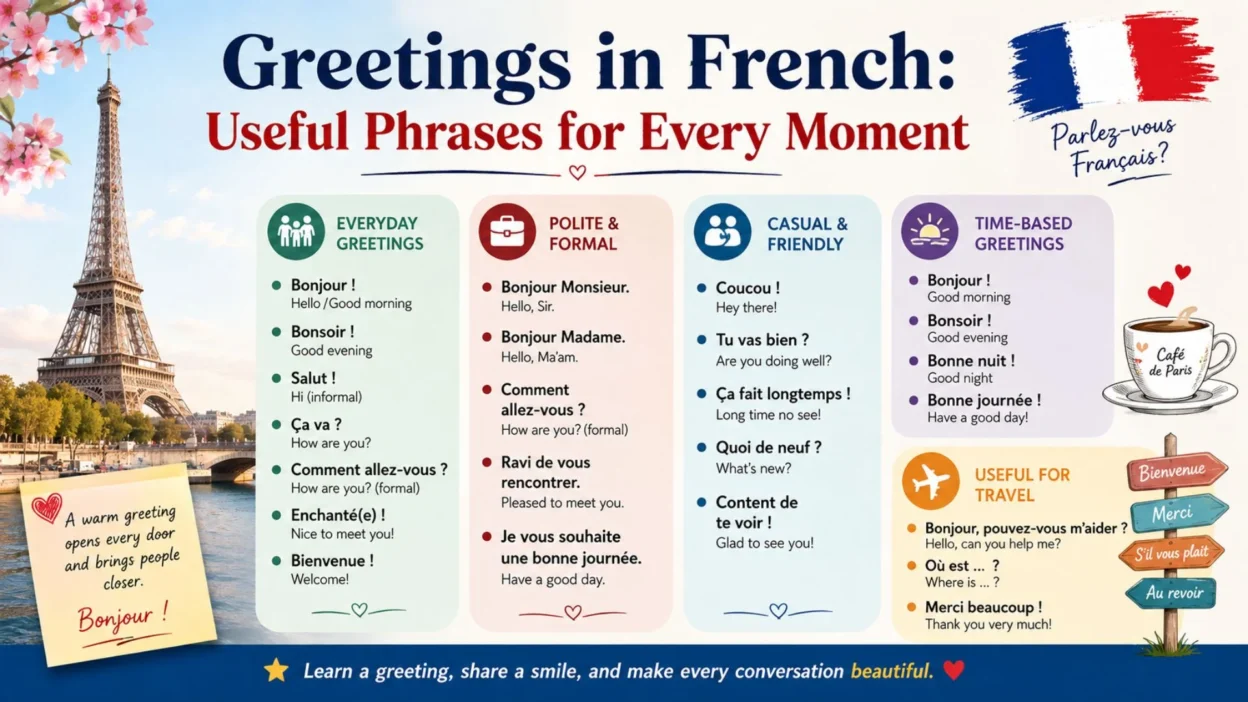
Learning a few warm words in another language can make even a simple conversation feel more personal. But when you are new to French, it can be difficult to know which greeting sounds natural and which one fits the situation. These greetings in French are designed to help you speak with confidence, whether you are meeting someone, traveling, texting a friend, or starting a polite conversation. You will find the French phrase alongside its natural English meaning, so you can quickly choose the right expression. Some greetings are formal, while others are relaxed and friendly, making it easier to avoid awkward wording. Use these ready-to-copy phrases whenever you want your French greeting to sound warm, respectful, and natural.
👋 Everyday Greetings in French for Simple Conversations
These everyday expressions are the best place to start if you want practical French you can actually use. They work well for introductions, shops, cafés, workplaces, and ordinary conversations.
- Bonjour ! — Hello! / Good morning! This is the safest and most widely used French greeting during the daytime.
- Bonsoir ! — Good evening! Use this when greeting someone later in the day or during the evening.
- Salut ! — Hi! A relaxed greeting that works naturally with friends, classmates, relatives, and people you know well.
- Bonjour, comment allez-vous ? — Hello, how are you? A polite option when speaking to someone formally or meeting them for the first time.
- Bonjour, comment vas-tu ? — Hello, how are you? Use this warmer version with a friend, child, relative, or someone you know well.
- Ça va ? — How are you? / Everything good? A very common casual greeting you will hear in everyday French conversation.
- Coucou ! — Hi there! A cheerful and affectionate greeting often used between close friends or family members. 😊
- Enchanté ! / Enchantée ! — Nice to meet you! A natural phrase to use immediately after being introduced to someone.
- Ravi de vous rencontrer. — Pleased to meet you. This sounds respectful and works well in professional or formal situations.
- Quel plaisir de vous voir ! — What a pleasure to see you! A lovely choice when you are genuinely happy to meet someone again. ❤️
- Bienvenue ! — Welcome! Use it when receiving a guest, welcoming someone to an event, or making a visitor feel comfortable.
Polite Greetings in French for Formal Situations
French culture places value on polite greetings, especially when speaking to strangers, professionals, older people, or anyone you do not know well. These phrases help you sound respectful without being overly formal.
- Bonjour Monsieur. — Hello, sir. A simple and respectful greeting for a man in a formal or public setting.
- Bonjour Madame. — Hello, ma’am. A polite greeting suitable for shops, offices, hotels, restaurants, and professional conversations.
- Bonjour, ravi de faire votre connaissance. — Hello, pleased to meet you. A polished expression for introductions at work or formal events.
- Comment allez-vous aujourd’hui ? — How are you today? This feels courteous and thoughtful when speaking formally.
- J’espère que vous allez bien. — I hope you are doing well. A warm phrase that works beautifully in both spoken conversations and messages.
- Je suis heureux de vous revoir. — I am happy to see you again. A respectful way for a man to greet someone he has met before.
- Je suis heureuse de vous revoir. — I am happy to see you again. This is the feminine form and carries the same warm meaning. 🌷
- C’est un plaisir de vous rencontrer. — It is a pleasure to meet you. Ideal for professional introductions or meaningful first meetings.
- Je vous souhaite une très bonne journée. — I wish you a very good day. A gracious phrase to use as a conversation comes to an end.
Casual Greetings in French for Friends and Family
When you are speaking with people you know well, French greetings can become much warmer and more relaxed. These options feel natural in texts, friendly conversations, family gatherings, and casual meetups.
- Salut, ça va ? — Hi, how are you? One of the easiest and most natural greetings to use with friends.
- Coucou, comment tu vas ? — Hey, how are you doing? Friendly, warm, and perfect for someone you feel close to.
- Ça fait longtemps ! — Long time no see! Use this when reconnecting with someone after you have not seen them for a while.
- Quoi de neuf ? — What’s new? / What’s up? A relaxed way to start catching up with a friend.
- Tu vas bien ? — Are you doing well? A simple question that can show genuine care when greeting someone.
- Content de te voir ! — Glad to see you! A friendly masculine form that shows real happiness about meeting someone again.
- Contente de te voir ! — Glad to see you! The feminine form is equally natural and affectionate.
- Ça me fait plaisir de te voir. — It makes me happy to see you. A warm greeting for a friend or loved one you have missed. 💛
- Hey, salut toi ! — Hey, you! A playful and informal greeting that works especially well in messages or friendly conversations.
- J’espère que tout va bien pour toi. — I hope everything is going well for you. A caring greeting when you want to sound more thoughtful. ✨
Morning Greetings in French to Start the Day Warmly
Morning greetings can make everyday conversations feel more cheerful and thoughtful. These greetings in French work well with family, friends, coworkers, or anyone you want to greet at the beginning of the day.
- Bonjour, passe une belle journée ! — Good morning, have a beautiful day! A warm phrase for someone you care about.
- Bonjour, j’espère que tu as bien dormi. — Good morning, I hope you slept well. Perfect for a partner, close friend, or family member.
- Bonjour à toi ! — Good morning to you! Short, friendly, and easy to use in a casual message.
- Je te souhaite une excellente journée. — I wish you an excellent day. A thoughtful greeting that feels encouraging without sounding too formal.
- Bonjour, que ta journée commence bien ! — Good morning, may your day start well! A positive way to send someone a little encouragement. ☀️
- Très bon matin à toi ! — A very good morning to you! A cheerful expression, though in France, simply saying “Bonjour” is generally more natural.
- Bonjour, j’espère que cette journée t’apportera de belles choses. — Good morning, I hope today brings you beautiful things.
- Passe une merveilleuse matinée. — Have a wonderful morning. A gentle message you can send before someone begins work, school, or daily activities.
- Bonjour ! Prêt pour une nouvelle journée ? — Good morning! Ready for a new day? A lively greeting for friends or coworkers.
- Je pense à toi ce matin. Bonjour ! — Thinking of you this morning. Good morning! A sweet greeting for someone special. ❤️
- Bonjour à tous ! — Good morning, everyone! A simple choice for groups, classrooms, meetings, or family chats.
- Belle journée à vous ! — Have a lovely day! A polite and natural expression for customers, colleagues, or acquaintances.
Greetings in French for Evening and Nighttime Conversations
Choosing the right evening phrase depends on whether you are arriving, leaving, or wishing someone a peaceful night. These expressions make that distinction much easier.
- Bonsoir ! — Good evening! Use this when meeting or greeting someone in the evening.
- Bonsoir, comment allez-vous ? — Good evening, how are you? A polished greeting for dinners, events, hotels, or formal meetings.
- Bonsoir, comment vas-tu ? — Good evening, how are you? A relaxed alternative for someone you know personally.
- J’espère que tu passes une bonne soirée. — I hope you are having a nice evening. Great for a friendly text or conversation.
- Passe une excellente soirée ! — Have an excellent evening! A natural phrase when saying goodbye later in the day.
- Je vous souhaite une agréable soirée. — I wish you a pleasant evening. A respectful option for professional or formal situations.
- Bonne soirée et prends soin de toi. — Have a good evening and take care. Warm and caring without sounding overly emotional.
- Bonsoir à tous ! — Good evening, everyone! Useful when entering a group gathering, event, or online conversation.
- Bonne nuit ! — Good night! Say this when someone is going to bed rather than when you first meet them in the evening. 🌙
Useful Greetings in French While Traveling
Knowing a few travel-friendly phrases can make hotels, restaurants, airports, shops, and public transport much easier to navigate. Start with a polite greeting before asking a question; it often makes the interaction feel more respectful.
- Bonjour, excusez-moi. — Hello, excuse me. An excellent way to politely get a stranger’s attention.
- Bonjour, pouvez-vous m’aider ? — Hello, can you help me? Useful when asking for directions or assistance.
- Bonjour, je voudrais poser une question. — Hello, I would like to ask a question. A polite opening when you need information.
- Bonjour, avez-vous une minute ? — Hello, do you have a minute? Respectful when approaching someone for help.
- Bonjour, je cherche cette adresse. — Hello, I am looking for this address. A practical phrase when navigating an unfamiliar city.
- Bonjour, une table pour deux, s’il vous plaît. — Hello, a table for two, please. A useful restaurant phrase that begins politely.
- Bonjour, j’ai une réservation. — Hello, I have a reservation. Perfect when arriving at a hotel or restaurant.
- Bonsoir, nous venons d’arriver. — Good evening, we have just arrived. Helpful when checking into accommodation later in the day.
- Merci beaucoup, bonne journée ! — Thank you very much, have a good day! A friendly way to end an interaction. 😊
- Au revoir, et merci pour votre aide. — Goodbye, and thank you for your help. A respectful closing after someone has assisted you.
Professional Greetings in French for Work and Business
Professional French usually sounds best when it is courteous, clear, and slightly more formal. These phrases work well in meetings, networking events, offices, and business conversations.
- Bonjour, je suis ravi de vous rencontrer. — Hello, I am pleased to meet you. A strong choice for a first professional introduction.
- Bonjour, merci de me recevoir. — Hello, thank you for meeting with me. Useful for interviews, appointments, and business meetings.
- Bonjour à toutes et à tous. — Hello, everyone. A polished way to address a mixed group at a meeting or presentation.
- Bonjour, j’espère que vous allez bien. — Hello, I hope you are well. Warm enough to sound human while remaining professional.
- C’est un plaisir de vous revoir. — It is a pleasure to see you again. Appropriate when reconnecting with a colleague or client.
- Merci d’être parmi nous aujourd’hui. — Thank you for being with us today. A welcoming phrase for meetings, events, or presentations.
- Bienvenue parmi nous. — Welcome to the team / Welcome among us. A kind greeting for a new colleague.
- Je suis heureux de faire votre connaissance. — I am pleased to meet you. A courteous masculine form for a new professional connection.
- Je suis heureuse de faire votre connaissance. — I am pleased to meet you. The feminine form carries the same respectful tone.
- Au plaisir de travailler avec vous. — I look forward to working with you. A useful phrase after an introduction or first meeting. 🤝
French Greetings for Text Messages and Social Chats
Texting allows French greetings to feel lighter and more personal. These phrases are useful when starting a conversation without sounding stiff or overly formal.
- Coucou, tu vas bien ? — Hey, are you doing well? Sweet and casual for someone close to you.
- Salut ! Comment se passe ta journée ? — Hi! How is your day going? An easy conversation starter.
- Hey, quoi de neuf ? — Hey, what’s new? Perfect for relaxed chats with friends.
- Coucou ! Ça fait un moment. — Hey! It’s been a while. Great when messaging someone after a long gap.
- Salut, j’espère que tout va bien. — Hi, I hope everything is going well. Simple, warm, and suitable for many situations.
- Un petit bonjour pour prendre de tes nouvelles. — Just saying hello to see how you are doing. A thoughtful message for someone you have not spoken to recently.
- Je voulais simplement te dire bonjour. — I simply wanted to say hello. Gentle and sincere when you do not need a specific reason to message.
- Coucou, je pensais à toi aujourd’hui. — Hey, I was thinking about you today. A caring greeting for someone special. 💛
Romantic Greetings in French for Someone Special
French can sound especially warm when you are greeting a partner or someone close to your heart. These greetings in French are affectionate without feeling overly dramatic, so they work naturally in texts and everyday conversations.
- Bonjour, mon amour. — Good morning/hello, my love. A simple and timeless greeting for your partner. ❤️
- Coucou, mon cœur ! — Hey, sweetheart! A cute and affectionate phrase for someone you are very close to.
- Bonjour, mon chéri. — Hello, my darling. Traditionally used when speaking affectionately to a man.
- Bonjour, ma chérie. — Hello, my darling. A warm version traditionally used when addressing a woman.
- Salut, toi ! Tu m’as manqué. — Hey, you! I missed you. Perfect when reconnecting after spending some time apart.
- Quel bonheur de te voir ! — What a joy to see you! A heartfelt greeting when seeing someone special again.
- Coucou, j’espère que ta journée commence bien. — Hey, I hope your day is starting well. Gentle and thoughtful for a morning message.
- Je suis tellement content de te voir. — I’m so happy to see you. A sincere masculine form for a romantic reunion.
- Je suis tellement contente de te voir. — I’m so happy to see you. The feminine version carries the same affectionate feeling.
Warm Greetings in French for Special Occasions
Sometimes an ordinary “hello” is not enough. Birthdays, holidays, celebrations, and meaningful reunions call for warmer words that recognize the moment.
- Joyeux anniversaire ! — Happy birthday! The standard and most natural birthday greeting in French. 🎂
- Félicitations ! — Congratulations! A versatile expression for weddings, promotions, achievements, and good news.
- Joyeuses fêtes ! — Happy holidays! A useful seasonal greeting around the end-of-year holiday period.
- Joyeux Noël ! — Merry Christmas! A traditional French Christmas greeting.
- Bonne année ! — Happy New Year! Use it when welcoming the new year with friends, family, or colleagues.
- Tous mes meilleurs vœux ! — My very best wishes! A warm expression suitable for celebrations and important occasions.
- Bienvenue chez nous ! — Welcome to our home! A lovely greeting when receiving guests.
How to Choose the Right Greetings in French
Choosing between French greetings becomes much easier once you consider your relationship with the other person. Bonjour is generally the safest choice during the day, especially with strangers, customers, older people, or professionals. In the evening, Bonsoir is the natural greeting when you first meet someone.
For friends and family, Salut and Coucou create a much more casual feeling. “Salut” is widely used, while “Coucou” often sounds more affectionate or playful. If you are unsure how familiar to be, starting with the more polite form is usually the better choice.
Another important distinction is between tu and vous. Use vous in formal situations or when speaking respectfully to someone you do not know well. Use tu with friends, close relatives, children, and people who have invited you to speak informally.
Also remember that Bonne nuit means “good night” and is usually said when someone is leaving for bed. If you arrive somewhere during the evening, Bonsoir is normally the appropriate greeting.
Common Mistakes to Avoid With Greetings in French
Learning a few small cultural differences can make your French sound noticeably more natural. Here are some common mistakes beginners can easily avoid.
- Do not use Salut automatically with everyone. It can sound too casual when speaking to a stranger, customer, teacher, or senior professional.
- Avoid translating every English greeting word for word. Natural French often uses Bonjour where English speakers might choose several different expressions.
- Do not use Bonne nuit as your first greeting at an evening event. Say Bonsoir when arriving and save Bonne nuit for bedtime.
- Be careful with tu and vous. Choosing vous is usually safer when you are uncertain about the appropriate level of familiarity.
- Remember to greet people before asking for something. Beginning with Bonjour before requesting help can make an interaction sound much more courteous.
- Do not worry about using complicated expressions immediately. A confident Bonjour, Bonsoir, or Salut often sounds better than an elaborate phrase used in the wrong context.
FAQs About Greetings in French
What is the most common greeting in French?
Bonjour is the most useful everyday French greeting. It generally means “hello” or “good morning” and works in shops, restaurants, workplaces, hotels, and most daytime conversations.
What is the difference between Bonjour and Salut?
Bonjour is more neutral and polite, while Salut is informal. Use Bonjour with strangers and in professional situations. Use Salut with friends, family members, classmates, and people you know comfortably.
How do you greet someone in French at night?
When meeting someone in the evening, say Bonsoir, meaning “good evening.” If the person is going to bed, you can say Bonne nuit, meaning “good night.”
Can I say Coucou to anyone in French?
Not usually. Coucou is affectionate and informal, so it is best used with friends, relatives, children, partners, or people you know well. In professional situations, choose Bonjour or Bonsoir instead.
What should I say when meeting someone for the first time?
Start with Bonjour and follow it with Enchanté or Enchantée, meaning “nice to meet you.” In a more formal setting, Ravi de vous rencontrer or C’est un plaisir de vous rencontrer also works beautifully.
Conclusion: Make Greetings in French Feel Natural
The best greetings in French are not always the longest or most impressive ones. What matters most is choosing a phrase that suits the person, time of day, and situation. Use Bonjour and Bonsoir when you want to stay polite, while Salut and Coucou are perfect for warmer, casual conversations. Keep this collection nearby whenever you need a quick French phrase for travel, work, friendships, texting, or someone special. Share your favorite expressions with others who are learning French, and practice them whenever you get the chance. A simple, sincere greeting can be the beginning of a beautiful conversation.